

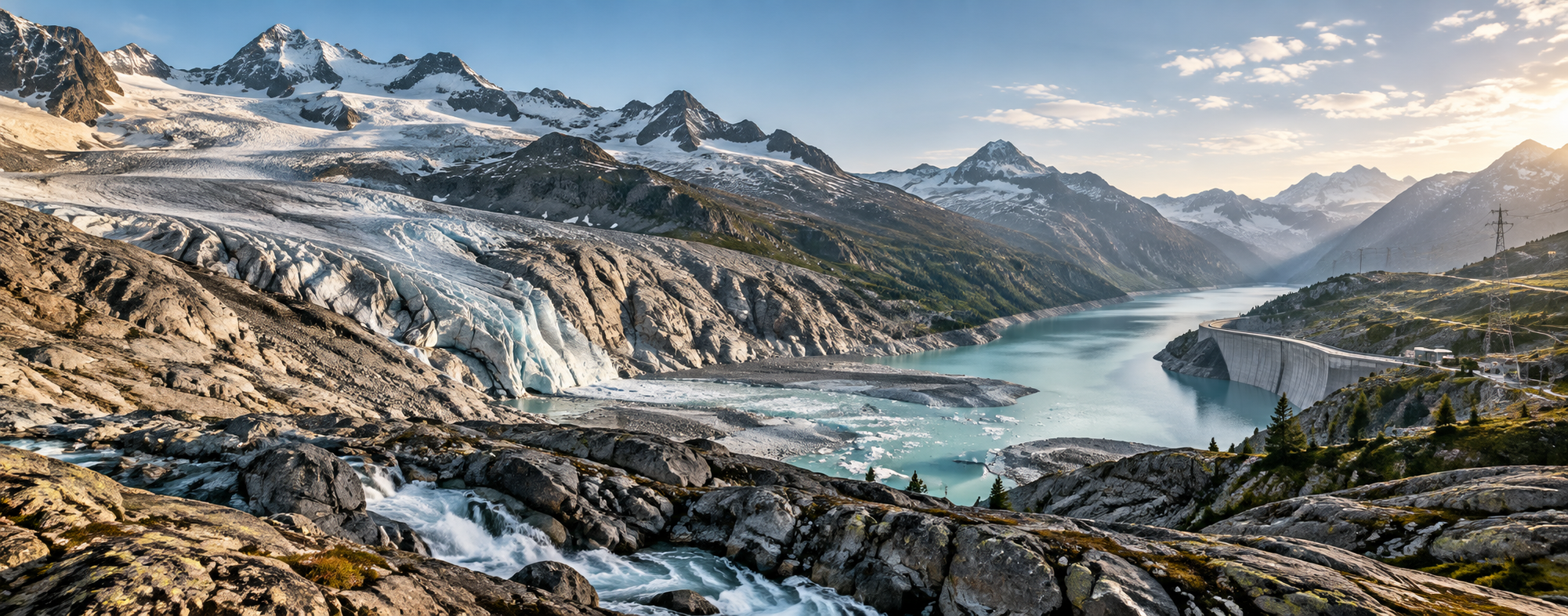
Swiss glacier melt 2026 – behind these words are figures that are extraordinary even by Swiss standards. More than five percent of Switzerland’s total glacier ice disappeared during this summer alone. Over the past five years, the loss has already reached almost 20 percent. What may initially appear to be primarily a climate issue is increasingly becoming a question of water availability, energy supply, infrastructure and technology.
For investors, it is precisely this second perspective that matters.
Glacier melt itself is not an investment theme. The technological responses to its consequences, however, can be.
More Than 2,200 Billion Litres of Water in Three Months
According to data from the Swiss Glacier Monitoring Network GLAMOS, Switzerland’s glaciers lost approximately 2,200 billion litres of water between July and September 2026 alone.
According to SRF, this corresponds to more than four times the annual drinking water consumption of all Swiss households.
Read the SRF report on Switzerland’s 2026 glacier melt
At first glance, this creates a paradox: when glaciers melt, additional water becomes available in the short term.
And that is exactly what is happening today.
Meltwater supports lakes and rivers during dry summer periods and contributes to filling reservoirs that can later be used for electricity generation.
But this effect is not permanent.
As glaciers become smaller, the Alps also lose part of their long-term natural water storage capacity. SRF points out that this stabilising effect is already declining as glacier surface area decreases. The German version of the article highlights the same relationship between glacier loss, water storage and infrastructure. Eingefügter Text
As a result, Swiss glacier melt 2026 is becoming more than an environmental story. It is increasingly an infrastructure issue.
Water Is Becoming a More Strategic Resource
Hydropower is a major component of the Swiss electricity system. Today, glacier meltwater can still contribute to filling reservoirs during the summer, making water available for electricity production during the winter.
However, SRF also highlights an important long-term dynamic: as glacier surface area continues to shrink, the additional contribution from glacier meltwater is expected to decline.
This increases the importance of a much broader technological ecosystem.
No single source of energy will determine the transformation. What matters increasingly is the interaction between different technologies:
hydropower, solar energy, wind energy, energy storage, smart grids, power electronics and digital energy management.
It is precisely this interconnection that makes Green Technology relevant from an investment perspective.
Glacier Melt Meets Energy Supply
Hydropower is a major component of the Swiss electricity system. Today, glacier meltwater can still contribute to filling reservoirs during the summer, making water available for electricity production during the winter.
However, SRF also highlights an important long-term dynamic: as glacier surface area continues to shrink, the additional contribution from glacier meltwater is expected to decline.
This increases the importance of a much broader technological ecosystem.
No single source of energy will determine the transformation. What matters increasingly is the interaction between different technologies:
hydropower, solar energy, wind energy, energy storage, smart grids, power electronics and digital energy management.
It is precisely this interconnection that makes Green Technology relevant from an investment perspective.
The Energy Transition Requires Much More Than Solar and Wind
But the underlying transformation goes much deeper.
As electricity generation becomes more electrified and decentralised, electricity grids, storage systems, transformers, control technologies and digital infrastructure become increasingly important.
A power grid originally designed around relatively predictable large-scale power plants must increasingly manage fluctuating and decentralised electricity generation.
At the same time, electricity demand is growing.
Electric mobility, data centres, heat pumps, industrial electrification and increasingly artificial intelligence all require electricity.
The energy transition is therefore not only about the question:
How is electricity generated?
It is equally about:
How is electricity stored, transported, distributed and used as efficiently as possible?
This is an important distinction from an investment perspective.
The visible technologies may attract much of the attention, but a significant part of the transformation is taking place behind the scenes – in networks, storage, electrical equipment, automation and infrastructure.
43% Less Glacier Ice Within 25 Years
According to GLAMOS data reported by SRF, the volume of Switzerland’s glaciers has declined by approximately 43 percent within just 25 years.
At the Great Aletsch Glacier, more than 25 metres of ice disappeared at Konkordiaplatz during the past five years alone.
Temperatures during the summer of 2026 were also exceptional. The zero-degree line rose above 4,000 metres on 76 days, while some glacier tongues lost as much as ten metres of ice thickness within a single season.
These are not abstract scenarios for the end of the century.
The changes can already be measured today.
And this also changes the investment perspective.
From Climate Protection to Climate Adaptation
That remains an important part of the transformation.
At the same time, however, another major field is becoming increasingly relevant: Climate Adaptation.
Climate adaptation refers to technologies and infrastructure that help economies and societies adjust to environmental changes that are already taking place.
Water networks need to become more efficient.
Buildings need to cope with higher temperatures while using as little energy as possible.
Electricity networks need to become more resilient.
Agriculture needs to remain productive while using fewer resources.
Industrial companies need to use energy and raw materials more efficiently.
This development significantly broadens the Green Tech investment universe.
It means that climate-related investment is no longer only about reducing future emissions.
It is increasingly also about making existing systems more efficient, resilient and adaptable.
Green Technology Is Becoming Infrastructure Technology
Our investment approach focuses on innovative technologies and long-term structural trends. Rather than looking at individual technologies in isolation, we consider how they interact within an increasingly interconnected technological ecosystem.
| Technology Area | Role in the Transformation |
|---|---|
| Renewable Energy | Expands low-carbon electricity generation through solar, wind and hydropower. |
| Smart Grids & Grid Infrastructure | Connects generation and consumption while enabling the integration of increasingly decentralised energy sources. |
| Energy Storage | Balances differences between electricity generation and demand over time. |
| Water Technology | Supports more efficient treatment, distribution and use of an increasingly strategic resource. |
| Energy Efficiency | Reduces energy consumption across buildings, industry and infrastructure. |
| Precision Agriculture | Enables more targeted use of water, energy, fertilisers and other resources. |
| Recycling & Circular Economy | Reduces raw-material consumption and returns valuable materials to the economic cycle. |
These areas are becoming increasingly interconnected.
Renewable energy requires powerful electricity grids and storage systems, while water technology, digitalisation and greater resource efficiency support the transformation across multiple industries.
The result is not a single market, but a technological ecosystem with long-term structural significance.
Learn more about our Green Tech Portfolio:
Green Tech Portfolio – Global Strategic Capital
The German source article uses the same seven technology areas and links them directly to Global Strategic Capital’s Green Tech approach.
The Investment Trend Lies Behind the Headlines
For long-term investors, however, another question is more important:
Which structural changes are taking place behind these images?
If water becomes less predictable or more seasonally constrained, the importance of efficient water systems increases.
If electricity generation becomes more variable, the need for electricity grids and energy storage increases.
If energy becomes more strategically important, energy efficiency becomes more valuable.
If emissions need to be reduced, markets related to electrification and renewable energy continue to develop.
These dynamics can create long-term investment opportunities that extend far beyond a single hot summer or individual climate event.
At Global Strategic Capital, our focus is on precisely these types of structural developments and the innovative technologies that can benefit from them over time.
Climate Adaptation and Green Tech Are Increasingly Connected
Many technologies can contribute to both.
A more efficient electricity grid, for example, supports the integration of renewable electricity while simultaneously making the energy system more resilient.
Energy-efficient buildings can reduce electricity consumption while also improving their ability to cope with periods of extreme heat.
Water technologies can improve resource efficiency while making communities and industries less vulnerable to periods of scarcity.
Precision agriculture can reduce water and fertiliser consumption while helping agricultural systems adapt to changing environmental conditions.
This interaction is important for investors because it expands the addressable market for many technologies.
The transition is no longer driven by one single objective.
Decarbonisation, resilience, efficiency and security of supply are increasingly reinforcing one another.
Infrastructure Is Moving to the Centre of the Green Trans
Generating renewable electricity is only one part of the challenge.
The electricity must also be transported.
It needs to be stored.
Networks must be expanded.
Buildings must become more efficient.
Industrial processes need to be electrified.
Water needs to be managed more intelligently.
Digital systems need to measure and optimise increasingly complex flows of energy and resources.
This creates demand across a broad range of industries.
Some of the companies benefiting from this transformation may therefore not necessarily be perceived as traditional “green” companies.
They may manufacture electrical equipment, grid components, industrial automation systems, sensors, software, water-treatment technologies or specialised materials.
What connects them is not necessarily a single industry classification.
It is their role in enabling a structural transformation of infrastructure.
Why This Matters for Long-Term Investors
They are driven by changes in technology, regulation, infrastructure needs, resource availability and economic behaviour.
Climate change adds another layer to these developments.
It does not create every investment trend by itself.
But it can accelerate the need for technologies that improve efficiency, resilience and resource management.
For long-term investors, the challenge is therefore not to predict individual weather events.
It is to identify which technological solutions are likely to become more important as underlying conditions change.
That requires looking beyond the most visible headlines.
The glaciers may be the most dramatic visual indicator.
But the economic transformation reaches far beyond the mountains.
Switzerland Is Showing Today What Could Become a Global Issue
It demonstrates how closely natural systems, water, energy and infrastructure are connected.
More than five percent of glacier ice lost within a single summer, almost 20 percent within five years and approximately 43 percent within 25 years illustrate how quickly systems once considered relatively stable can change. These figures are all central to the current German article and its investment framing. Eingefügter Text Eingefügter Text
For investors, the relevant question is therefore not how to predict short-term climate events.
The more important question is:
Which companies are developing technologies that can help address long-term structural challenges?
Glaciers are a visible indicator of change.
The underlying investment trend lies in the technologies needed as the world around them changes.
Further Reading
SRF:
Massive Glacier Melt – How Much Ice Disappeared During the Hot Summer of 2026
Global Strategic Capital:
Portfolios & Expertise
Green Tech Portfolio:
Learn more about the Green Tech Portfolio