

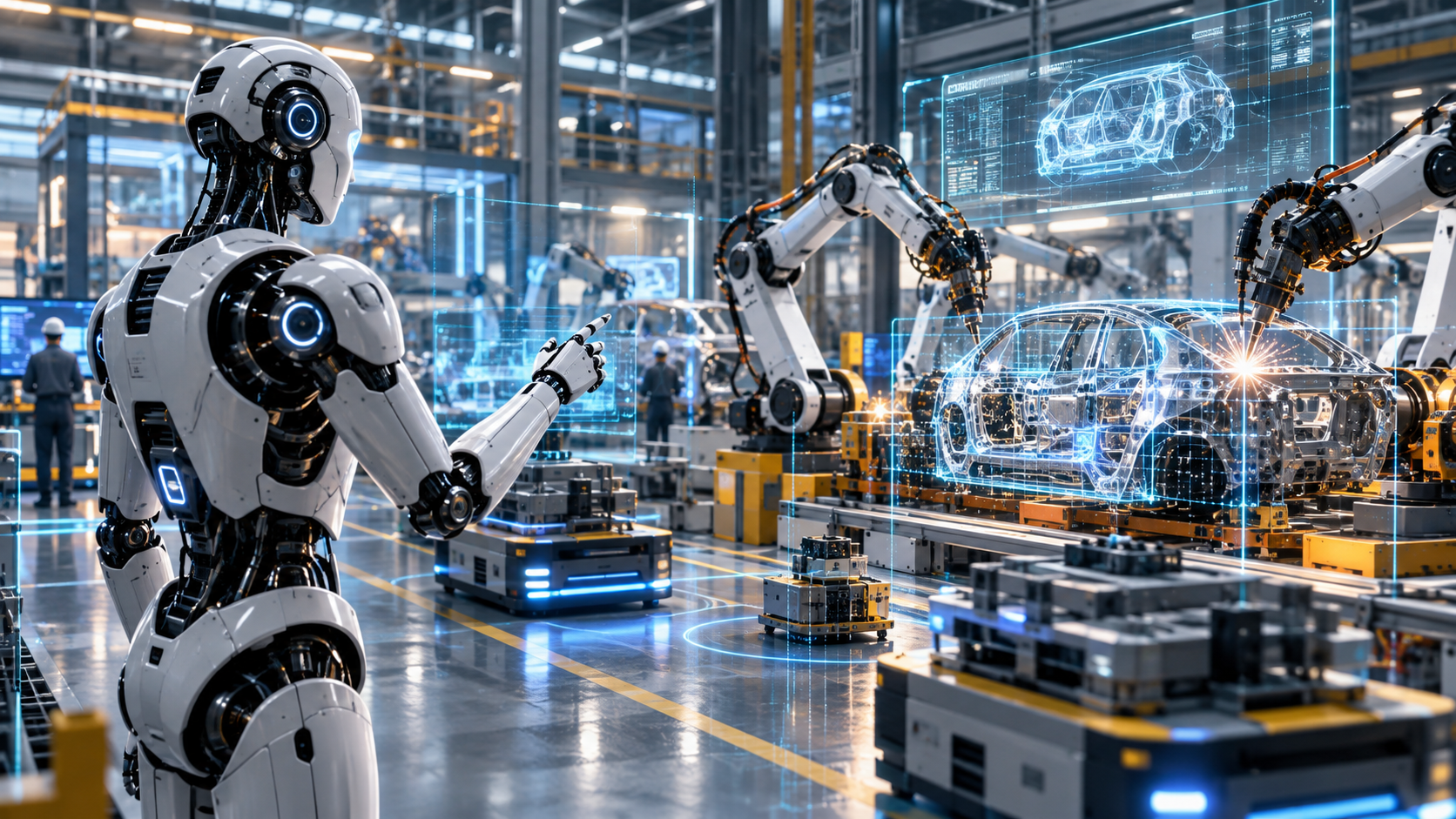
Physical AI could mark the next major stage in the evolution of artificial intelligence. While generative AI has primarily transformed text, images, software and digital content, artificial intelligence is increasingly beginning to understand and interact with the physical world. Robots can see, learn, make decisions and perform actions. In other words, AI is gaining eyes, hands and legs.
For industry, this development could open a new era of automation. Industrial robots, autonomous mobile systems and humanoid robots may not only change individual production processes but reshape entire value chains.
A new technology ecosystem is emerging in which artificial intelligence, semiconductors, simulation, sensors, robotics and industrial automation increasingly converge.
What Is Physical AI?
Physical AI refers to artificial intelligence that does not operate exclusively in a digital environment but interacts with and controls physical systems.
A conventional AI model processes information and generates a digital response.
A Physical AI system faces a more complex task. It must perceive its environment, understand what is happening, make a decision and then translate that decision into an action in the real world.
The process can be simplified into three stages:
Perceive → Understand → Act
To achieve this, intelligent machines require several technologies working together:
- Cameras, sensors and machine vision
- High-performance semiconductors
- Artificial intelligence and machine learning models
- Edge computing
- Industrial networks
- Digital twins and simulation
- Motors and actuators
- Robotics software
- Safety and cybersecurity systems
Physical AI therefore connects the digital intelligence of AI with physical hardware.
Why Physical AI Is Becoming Important Now
Robots themselves are not new. Industrial robots have been used in manufacturing for decades.
What is changing is their level of intelligence and autonomy.
Traditional industrial robots are typically programmed to perform highly defined and repetitive movements. When the production environment changes, significant reprogramming or engineering may be required.
Artificial intelligence is beginning to change this model.
Modern robotic systems can increasingly interpret visual information, recognize objects, optimize movements and learn new tasks through simulation.
The International Federation of Robotics identifies AI and autonomy in robotics as one of the major global robotics trends of 2026. According to the IFR, generative AI is helping robotics move from purely rule-based automation toward more adaptable systems capable of learning new tasks and generating training data through simulation.
The shift is important.
A robot is gradually evolving from a programmed machine into an intelligent system capable of adapting to its environment.
ABB and NVIDIA: Bringing Physical AI to the Factory Floor
One of the clearest examples of this transformation comes from the collaboration between ABB Robotics and NVIDIA.
In March 2026, ABB Robotics announced that it would integrate NVIDIA Omniverse libraries into its RobotStudio platform to help bring industrial-grade Physical AI into real-world manufacturing environments.
ABB Robotics – Physical AI and RobotStudio HyperReality
NVIDIA – ABB Robotics and Omniverse
The new solution, called RobotStudio HyperReality, combines ABB’s robotics expertise with NVIDIA’s simulation technology.
The objective is to narrow one of the most important gaps in modern robotics: the gap between simulation and reality.
Before a robot operates on an actual production line, engineers can create a highly realistic digital version of the environment. Robots can then be programmed, tested and increasingly trained in this virtual environment before deployment.
ABB states that the technology can achieve up to 99% correlation between virtual training and real-world deployment, reduce engineering and production costs by up to 40%, and accelerate time to market by as much as 50%.
The technology also enables robots to train using synthetic data across numerous simulated scenarios.
This highlights why simulation could become a critical building block of Physical AI.
Instead of learning exclusively through expensive physical testing, intelligent machines can experience thousands or millions of scenarios virtually before entering the real world.
NVIDIA Is Building an Ecosystem for Physical AI
For NVIDIA, robotics represents a natural extension of the artificial intelligence infrastructure it has helped build.
The company is expanding beyond the chips used to train AI models toward an ecosystem covering simulation, AI models, autonomous systems and edge computing.
NVIDIA describes Physical AI as systems capable of perceiving, reasoning and acting in the real world. Its technology stack includes tools for high-fidelity simulation, synthetic data generation and AI deployment in robots and autonomous machines.
This creates an important connection between two technological investment themes.
The first phase of the AI boom focused heavily on building the infrastructure required to train and run increasingly powerful artificial intelligence models.
Physical AI expands that infrastructure into the real economy.
Data centers may train the intelligence.
Robots can ultimately put that intelligence to work.
Robotics Is Already a Large Global Industry
Physical AI is not emerging in isolation. It is being built on top of an already significant global robotics market.
According to the International Federation of Robotics, approximately 542,000 industrial robots were installed worldwide in 2024.
Annual installations exceeded 500,000 units for the fourth consecutive year.
At the end of 2024, approximately 4.66 million industrial robots were operating worldwide.
Asia accounted for approximately 74% of new installations, while China alone represented 54% of global deployments.
The IFR expects annual installations to exceed the 700,000-unit level by 2028.
These figures demonstrate an important point.
Physical AI does not need to create an entirely new industry.
Instead, artificial intelligence can increasingly be integrated into millions of existing and future machines.
Humanoid Robots: Revolution or Hype?
Humanoid robots are currently the most visible expression of Physical AI.
The logic behind their design is compelling.
Factories, warehouses, offices, buildings and tools have largely been designed around the human body. A robot with human-like capabilities could therefore potentially operate in existing environments without requiring every process to be redesigned around traditional automation.
Automotive manufacturers and logistics companies are already experimenting with humanoid systems for tasks such as material handling, machine tending and repetitive manufacturing processes.
The market, however, remains at a very early stage.
According to data reported by the International Federation of Robotics, around 7,000 humanoid robots were sold globally for industrial and professional service applications in 2025. This remains extremely small compared with the conventional industrial robot market.
The IFR therefore stresses that humanoids still need to prove their reliability and efficiency under real industrial conditions.
Key questions include:
- Can the robot operate reliably over long production cycles?
- What are the acquisition and maintenance costs?
- How much energy does it consume?
- Can it perform different tasks consistently?
- Can it safely operate alongside humans?
- How quickly can the investment generate an economic return?
The IFR highlights cycle times, energy consumption, maintenance costs, safety and productivity as critical factors determining whether humanoid robots can compete with established automation technologies.
This is where technological excitement needs to be separated from commercial reality.
Physical AI Is Much Bigger Than Humanoid Robots
The long-term investment theme is therefore broader than humanoid robotics alone.
Physical AI can take many different forms.
Industrial Robots
AI-powered robotic arms can become more flexible and potentially handle more complex manufacturing processes.
Autonomous Mobile Robots
Factories and warehouses increasingly use autonomous systems to transport goods, optimize material flows and adapt routes dynamically.
Machine Vision
AI-enabled cameras can inspect products, identify manufacturing defects and monitor industrial processes.
Autonomous Machinery
Construction equipment, agricultural machinery and industrial vehicles can gradually become more autonomous.
Service Robots
AI-powered robots can increasingly support logistics, healthcare, hospitality, cleaning and other service industries. The IFR noted in September 2026 that advances in AI, perception and autonomous navigation are helping professional service robots move from niche applications toward broader commercial deployment.
Humanoid Robots
Humanoids could eventually address situations where maximum flexibility is required in environments originally designed for people.
The broader investment opportunity may therefore be described as something larger than simply robotics.
It is about adding intelligence to the physical economy.
From AI Factories to Intelligent Factories
The long-term investment theme is therefore broader than humanoid robotics alone.
Physical AI can take many different forms.
Industrial Robots
AI-powered robotic arms can become more flexible and potentially handle more complex manufacturing processes.
Autonomous Mobile Robots
Factories and warehouses increasingly use autonomous systems to transport goods, optimize material flows and adapt routes dynamically.
Machine Vision
AI-enabled cameras can inspect products, identify manufacturing defects and monitor industrial processes.
Autonomous Machinery
Construction equipment, agricultural machinery and industrial vehicles can gradually become more autonomous.
Service Robots
AI-powered robots can increasingly support logistics, healthcare, hospitality, cleaning and other service industries. The IFR noted in September 2026 that advances in AI, perception and autonomous navigation are helping professional service robots move from niche applications toward broader commercial deployment.
Humanoid Robots
Humanoids could eventually address situations where maximum flexibility is required in environments originally designed for people.
The broader investment opportunity may therefore be described as something larger than simply robotics.
It is about adding intelligence to the physical economy.
Physical AI and Our Investment Strategies
Physical AI connects several structural investment themes that we follow at Global Strategic Capital.
AI Infrastructure Portfolio
Our AI Infrastructure Portfolio focuses on the technological foundation required for artificial intelligence.
The strategy covers areas including semiconductors, computing power, memory and storage, network infrastructure, data centers, energy efficiency and power supply.
Explore the Global Strategic AI Infrastructure Portfolio
Physical AI adds another potential layer of demand to this infrastructure.
Before an autonomous robot can make intelligent decisions in the physical world, AI models must be trained, processed and deployed using increasingly powerful computing infrastructure.
Physical AI could therefore extend the AI infrastructure cycle from digital applications into factories, logistics systems and autonomous machines.
NextGenTec Portfolio
Our NextGenTec Portfolio focuses on some of the fastest-growing companies across major technology megatrends.
The portfolio targets businesses demonstrating annual revenue growth above 20%, with exposure to areas including artificial intelligence, cloud and network infrastructure, deep technology and other future technologies.
Explore the Global Strategic NextGenTec Portfolio
Physical AI sits at the intersection of several of these trends.
Artificial intelligence, advanced semiconductors, cloud infrastructure, automation and robotics are increasingly becoming part of the same technological ecosystem.
Innovation Portfolio
Our Innovation Portfolio follows a core-satellite strategy designed to combine broad technology exposure with targeted participation in structural innovation themes.
Its thematic universe includes artificial intelligence, semiconductor technologies, cloud computing and Robotics & Automation, among other areas.
Explore the Global Strategic Innovation Portfolio
Physical AI is a good example of why these technology categories can no longer always be viewed independently.
AI requires semiconductors.
Robots require AI.
Autonomous machines require sensors, networking and computing.
Simulation connects the digital and physical worlds.
The technologies increasingly reinforce one another.
Where Are the Risks?
Despite its technological potential, Physical AI remains at an early stage in many areas.
This is particularly true for humanoid robots.
High development costs, complex mechanical systems, energy requirements, safety standards and maintenance costs can slow commercialization.
Cybersecurity will also become increasingly important.
A chatbot generating an incorrect answer creates one category of risk.
An autonomous machine making an incorrect decision in a factory, warehouse or public environment creates an entirely different one.
As intelligent machines become more connected and autonomous, reliability, safety, cybersecurity and regulatory standards will become increasingly important.
The IFR therefore identifies robot safety and cybersecurity as another major robotics trend for 2026.
From an investment perspective, another risk is equally important:
Not every impressive technology will become a successful business.
Technological leadership must eventually translate into scalable products, growing revenues, attractive margins and sustainable competitive advantages.
Conclusion: AI Is Getting a Body
The first major wave of generative AI demonstrated how powerful artificial intelligence can become in the digital world.
Physical AI could bring that intelligence into the physical economy.
Industrial robots are becoming smarter.
Machines can increasingly train inside virtual environments.
Autonomous systems are becoming better at interpreting the world around them.
Humanoid robots are beginning to move from laboratories into early commercial testing.
Whether humanoid robots themselves ultimately become a mass-market technology remains uncertain.
The broader trend, however, is already visible:
Artificial intelligence is evolving from a digital tool into a technology capable of perceiving, understanding and acting in the physical world.
For investors, this creates an expanding ecosystem at the intersection of artificial intelligence, semiconductors, computing infrastructure, simulation, sensors, automation and robotics.
The AI Factory may have built the intelligence.
The next step could be putting that intelligence to work in the real world.