

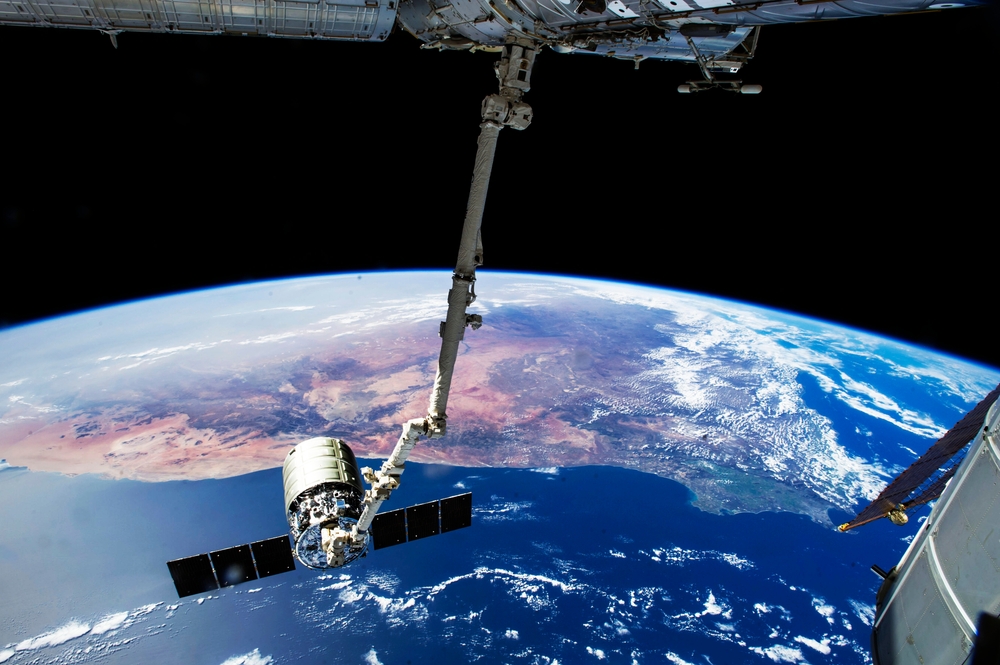
Space Economy is no longer a distant vision of the future. It is becoming one of the most dynamic growth sectors in the global economy. What was once the exclusive domain of superpowers is now opening up to private companies, new technologies and investors who recognize early where the next major wave of value creation may emerge.
From Government Missions to a Global Industry
The commercial space industry is undergoing its most significant structural transformation since the Space Race of the 1960s. For decades, organizations such as NASA, ESA and Roscosmos set the pace. Today, private companies are increasingly driving innovation, cost efficiency and commercialization.
A key driver of this development is the dramatic reduction in launch costs. SpaceX, through the Falcon 9 rocket and the concept of reusability, has fundamentally changed the economics of access to orbit. What once required billions in public funding can now be achieved at a fraction of historical costs — a paradigm shift with immediate economic consequences.
Market forecasts underline the scale of this transformation. According to the World Economic Forum and McKinsey, the global space industry could reach USD 1.8 trillion by 2035, up from USD 630 billion in 2023. This reflects the growing relevance of space-based technologies for communication, navigation, Earth observation, logistics, climate analysis and national security.
Three Segments — One Megatrend
The New Space market is not a single, uniform sector. It consists of several clearly defined segments, each with different risk-return profiles and different access points for investors.
Satellite communication and Earth observation currently represent the largest areas of activity. Satellite networks are changing global connectivity and creating new use cases in telecommunications, maritime logistics, precision agriculture, supply-chain monitoring, climate analytics and defense.
Launch services and infrastructure are also expanding rapidly through reusable rocket systems, miniaturized satellites and new launch sites around the world. Lower costs and more frequent launch windows are enabling a broader range of commercial applications and allowing smaller companies to enter the market.
Space tourism and the emerging in-space economy remain early-stage segments today, but they offer long-term potential as orbital infrastructure, commercial space stations, lunar logistics and private space missions become more realistic over the coming decade.
Geopolitics as an Additional Growth Driver
The space sector is now far more than science and exploration. It has become strategic infrastructure. The increasing rivalry between the United States, China and Europe is accelerating government investment in satellite systems, secure communication networks, autonomous launch capacity and space-based intelligence.
Europe is also gaining momentum in this field. Governments are investing more actively in independent space infrastructure, while private aerospace companies are becoming increasingly important for national and regional resilience.
For investors, this means that growth in the industry is not only market-driven. It is also politically supported. Government contracts, long-term concessions and strategic partnerships can create a more stable revenue base for selected companies.
Opportunities and Challenges for Investors
Access to the most attractive private space companies remains limited for public market investors. Companies such as SpaceX and Blue Origin are still privately held, which makes a disciplined allocation strategy particularly important.
Listed companies nevertheless offer selected opportunities. Examples include Rocket Lab in launch services and space systems, OHB as a European space and satellite systems integrator, and Intuitive Machines in commercial lunar logistics. Thematic ETFs may also offer broader participation while reducing single-stock risk.
Space-related investments require a long-term horizon. Technical setbacks, project delays, high capital intensity and regulatory uncertainty are inherent risks in this industry. Investors should therefore combine thematic conviction with careful position sizing, diversification and active risk management.
Conclusion: An Industry Taking Off
The commercialization of space is already reality. Satellites deliver real-time data for supply chains, climate research and global communication. Commercial rockets transport cargo to the International Space Station, and paying customers have already reached orbit.
For investors, this development offers a rare opportunity to participate early in a megatrend supported by technological progress, falling costs and geopolitical necessity. The theme combines innovation, infrastructure and strategic relevance into a global growth market with long-term significance.
Through our Innovation Portfolio and our NextGenTec Portfolio, we already invest selectively in this segment and position our portfolios early in one of the most exciting growth markets of the coming decade.
Further Reading
Investors can learn more about our broader investment approach in our Expertise section. For external research, we recommend the World Economic Forum report Space: The $1.8 Trillion Opportunity for Global Economic Growth, which outlines the long-term growth potential of the global space industry.
Spot early. Decide smart. — With our Investment Update.
The future of markets starts here — stay informed with our Investment Update.