

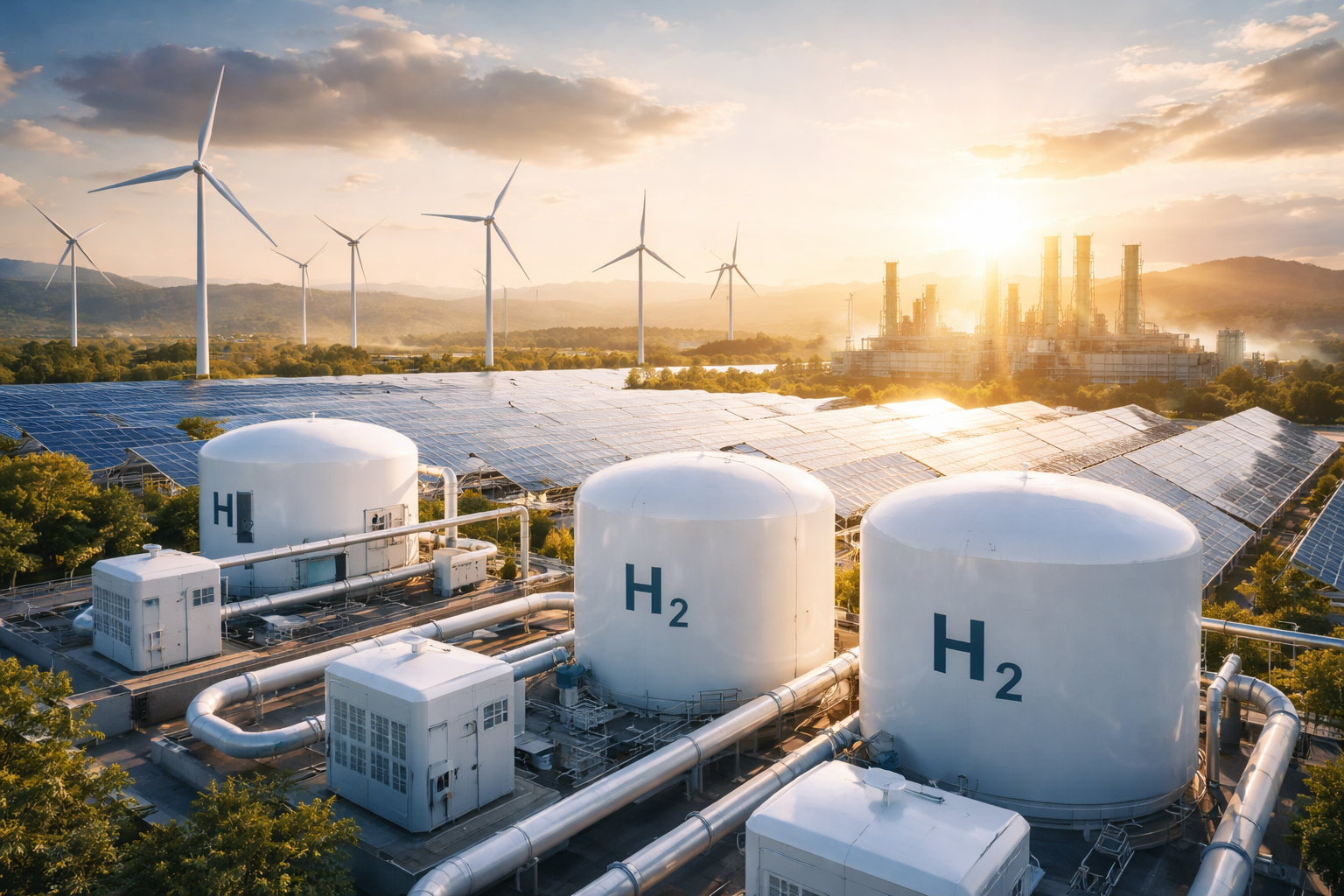
Hydrogen investment Europe is gaining increasing strategic importance.
Investment Update — Hydrogen Portfolio 2025 USD (D) | March 2026
Dear investors,
Hydrogen as an investment theme is gaining increasing strategic importance in Europe. Europe’s dependence on imported energy remains one of the continent’s most pressing structural challenges. The response to this issue is increasingly summarized in a single word: hydrogen.
What was once considered a future topic is now taking concrete shape in the European real economy — in pipelines, electrolyzers, and industrial facilities. Our Hydrogen Portfolio has performed well in this environment
Portfolio Performance 2025 and 2026
As of the end of March 2026, the portfolio has achieved a +55.31% return over twelve months, with a year-to-date gain of +17.47%. The year 2025 closed with a +32.47% increase.
The Sharpe ratio stands at 2.12, and the correlation with the MSCI World is only 0.38. This highlights the portfolio’s strong diversification benefits and positions it as an independent, alpha-generating asset class.
Below, we outline the broader context and our investment approach.
Energy Independence as Europe’s Strategic Priority
Europe currently sources a significant portion of its energy from politically unstable regions. Following the near-complete loss of Russian gas supplies, the continent shifted toward LNG imports — from the United States, Qatar, and Norway.
While this diversification reduced concentration risk, it did not eliminate structural dependence. Energy, regardless of its origin, remains a geopolitical instrument. Any region reliant on imports is inherently vulnerable.
The conclusion drawn by policymakers and industry alike is clear: Europe must increasingly produce its own energy.
Renewables can supply electricity, but energy-intensive industries, seasonal storage, and high-temperature processes require an energy carrier that is storable, transportable, and versatile. Hydrogen fulfills this role.
What Is Already Happening in the European Economy
The development of a European hydrogen economy is no longer theoretical — it is underway.
- In December 2025, the network operator Gascade converted a 400 km pipeline from the Baltic coast to Saxony-Anhalt for hydrogen transport — the first operational segment of Germany’s hydrogen core network.
- The network is expected to expand to 9,000 km by 2032, with investments exceeding €27 billion.
- Since early 2026, market participants can reserve binding capacities.
Industrial Transformation
- ThyssenKrupp is building Europe’s largest hydrogen-ready direct reduction plant in Duisburg, supported by €2 billion in public funding.
- Capacity: 2.5 million tons of DRI
- Potential CO₂ savings: up to 3.5 million tons annually
- Gradual transition to full hydrogen operation from 2028
- Salzgitter has already commissioned a 100 MW electrolyzer, producing 9,000 tons of hydrogen per year for its steel operations.
Infrastructure Expansion
- In the Netherlands, Gasunie is developing a national hydrogen backbone to position the country as a hub for Northwestern Europe.
- In Lingen, RWE and BP each plan to build 100 MW electrolyzers by 2027.
- The European Commission has announced a €240 billion infrastructure package for hydrogen networks through 2040, including accelerated approval for 100 hydrogen and electrolyzer projects.
Challenges and Market Dynamics
The transition is not without friction:
- Green hydrogen remains expensive
- Infrastructure is developing gradually
- Some industrial projects have adjusted timelines
However, this transitional phase — characterized by investment pressure, regulatory incentives, geopolitical necessity, and technological maturation — is precisely what creates the market dynamics our strategy seeks to capture.
Note: What Is Direct Reduction?
A direct reduction plant is a steel production facility where iron ore is reduced directly to iron without using a blast furnace.
Traditionally, blast furnaces use coke (derived from coal), generating large amounts of CO₂. In direct reduction, a reducing gas replaces coke — historically natural gas, and increasingly hydrogen.
The result is Direct Reduced Iron (DRI), which is then processed into steel using an electric arc furnace.
The key advantage:
When hydrogen is used, the only byproduct is water vapor — not CO₂.
This makes hydrogen-based direct reduction one of the most promising pathways to decarbonize steel production, which currently accounts for 7–8% of global CO₂ emissions.
Our Strategy: Momentum Selection Along the Value Chain
The Hydrogen Portfolio invests selectively in companies with the strongest price momentum across three core segments:
- Green Hydrogen Production
- Pure Plays
- Solution Providers
The selection follows a strict momentum-based approach, analyzing both absolute and relative momentum. Positions are only held as long as they maintain a confirmed upward trend and are sold systematically when criteria are no longer met.
Outlook
The transition toward a more independent European energy system is a long-term structural shift.
For investors, the hydrogen sector can serve as a valuable addition — not as a replacement for core holdings, but as an independent return driver with low correlation to broader markets.
We remain available for professional discussions and welcome direct engagement.
Further Reading
- EU Hydrogen Strategy (European Commission)
→ https://energy.ec.europa.eu/topics/eus-energy-system/hydrogen_en - European Hydrogen Backbone Initiative
→ https://ehb.eu/ - Hydrogen Network Expansion & Projects by GASCADE
→ https://www.gascade.de/en/hydrogen/hydrogen-in-europe