

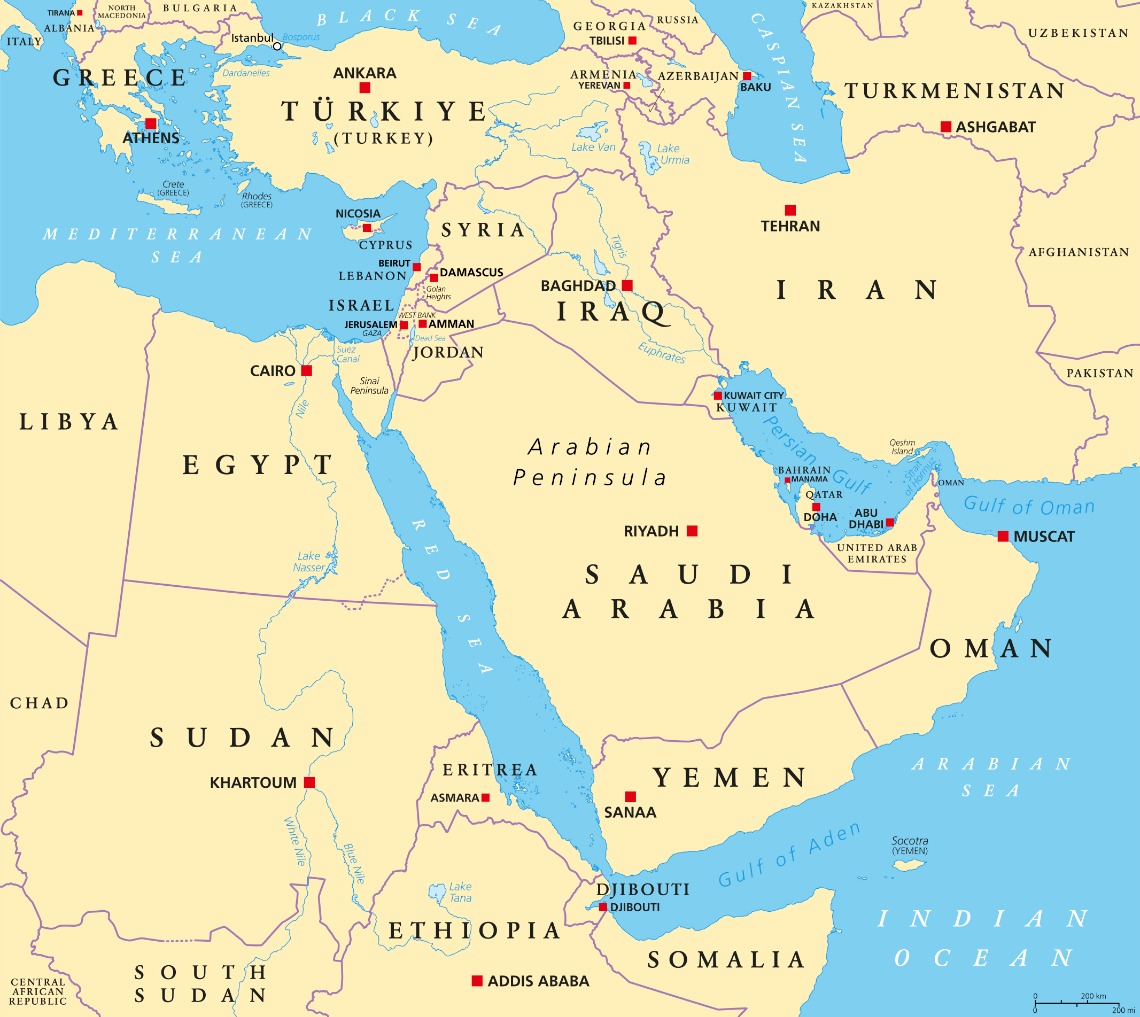
Middle East Escalation 2026:
Dear Investor,
With this update, we would like to inform you of our assessment of the current situation in the Middle East and the resulting measures taken in our portfolios.
Military Situation – A Brief Overview
The military reality is sobering: none of the actors involved is in a position to “win” this war in the conventional sense. The US and Israel possess superior air strike capabilities – but no air campaign alone can bring about political change in a country of over 90 million people.
Iran’s strength lies in an asymmetric warfare strategy built up over decades. Rather than relying on conventional armed forces, Tehran has invested heavily in a network of regional proxy groups: Hezbollah in Lebanon, Shia militias in Iraq, Hamas and Islamic Jihad in Gaza, and the Houthis in Yemen.
Cost Asymmetry – Calculated Strategy
A Shahed drone costs Iran between $20,000 and $50,000 to produce. The American Patriot intercept system expends missiles worth approximately $4 million per intercept – THAAD missiles cost over $10 million each. This cost inversion is no coincidence, but a deliberate calculation.
Iran’s defense doctrine is based on the principle of “Mosaic Defense”: decentralized, semi-autonomous IRGC units operate largely independently and are difficult to neutralize through decapitation strikes. Iran can prolong the war, export economic damage to global markets, and raise the cost for the opposing side – without having to declare its own defeat.
Iraq as a Second Front: Shia Militias Attack US Forces
Since late February, over 500 attacks have been recorded against targets in Iraq or launched from Iraqi territory against regional actors. The majority are attributed to Shia militias allied with Iran.
A lasting military victory appears unattainable for either side.
Diplomatic Situation – Negotiations or Illusion?
What followed speaks for itself: overnight on Saturday, the US and Israel bombed two of Iran’s largest steel plants as well as nuclear facilities, including the heavy water complex in Arak and a uranium processing plant in Yazd. Iran subsequently threatened retaliatory strikes on steel plants in Saudi Arabia, the UAE, Qatar, Kuwait, Bahrain, and Israel.
Our Assessment
Can strikes on civilian industrial infrastructure and nuclear facilities – while simultaneously announcing negotiations – be considered confidence-building measures?
At this point in time, there are no substantive diplomatic talks taking place.
The “Escalation Trap” – and Further Escalation Risks
Prof. Robert Pape is one of the leading experts on airpower strategy and has advised the Pentagon and several US administrations on national security matters over several decades.
Pape describes the “Escalation Trap” as the dynamic in which tactical successes lead decision-makers to systematically underestimate the enemy’s capacity for resistance. Precision munitions reliably hit their targets – but the objective is not the destruction of objects; it is changing the adversary’s policy. It is precisely this gap between military success and political outcome that drives wars toward escalation.
Pape describes three stages of the trap:
- Conviction of possessing escalation dominance
- Belief in the ability to control escalation
- Loss of control over the war by those who initiated it
A ground operation as the third stage would have catastrophic consequences not only for the directly involved parties, but for the global economy as a whole.
Further Escalation Risk: The Pakistan Factor
An often underestimated risk in the current crisis is the role of Pakistan. Iran and Pakistan have traditionally maintained close relations. At the same time, a significant new counterweight has emerged since September 2025: on September 17, 2025, Saudi Arabia and Pakistan signed the “Strategic Mutual Defence Agreement” (SMDA) – a mutual defense pact under which any aggression against one of the two states is considered aggression against both.
Critical Factor: Pakistan
Pakistan is a nuclear power. The SMDA raises the question of whether Saudi Arabia is now implicitly under a nuclear umbrella. Pakistan potentially stands simultaneously in its traditional relationship with Iran and in a formal defense alliance with Saudi Arabia. The escalation potential of this tension is barely priced into markets.
The Houthis Strike Israel – A New Belligerent Enters the War
In the early hours of March 28, 2026, the Houthis launched a barrage of ballistic missiles at Israel from Yemen – their first direct attack since the outbreak of the US-Israeli war against Iran. Spokesman Yahya Saree stated that operations would continue “until the declared objectives are achieved.”
The Houthis are militarily stronger than is widely appreciated. According to UN estimates, they command up to 350,000 fighters – a figure that has risen sharply since the Gaza war in 2023. This makes them numerically larger than many regular armies in the region. They possess ballistic missiles with a claimed range of up to 2,000 km and attack drones with a range of up to 2,500 km – sufficient to strike Israel directly from Yemeni territory. Their arsenal includes Iranian-derived long-range missiles of the Toufan and Quds series, anti-ship missiles, and unmanned combat vessels for maritime operations.
US defense experts have acknowledged the group’s remarkable capabilities with a degree of grudging respect: “They iterate and they’re pretty innovative – our assessment is that a lot of the actual production takes place in Yemen.” Repeated US and Saudi airstrikes on their infrastructure have so far failed to significantly degrade this capacity.
The most strategically significant risk, however, does not lie in the missile attacks on Israel themselves. Houthi Deputy Minister Mohammed Mansour stated explicitly: “Closing the Bab el-Mandeb Strait is among our options.” Analysts warn that the Houthis could use this threat to strengthen Iran’s negotiating position while simultaneously putting further pressure on global energy markets.
Should this materialize, both of the Middle East’s major maritime corridors – the Strait of Hormuz and the Bab el-Mandeb – would be simultaneously blocked: a scenario without precedent in modern history, with dramatic consequences for energy supply, global supply chains, and financial markets worldwide.
The Petrodollar – An Underestimated Market Risk
The closure of the Strait of Hormuz has led to a systemic collapse of the Gulf states’ economic model. The combined oil production of Kuwait, Iraq, Saudi Arabia, and the UAE has fallen by at least 10 million barrels per day by mid-March. This is compounded by the complete halt of Qatar’s LNG exports and a massive decline in tourism revenues.
The petrodollar system – the foundation of global dollar dominance since 1974 – works, in simplified terms, as follows: oil is invoiced in US dollars, and the export revenues of the Gulf states flow into USD-denominated assets such as US Treasuries, private debt, equities, and real estate. This cycle finances a significant portion of US government debt, which now exceeds $39 trillion, with annual interest payments of over $1 trillion.
What happens when the export revenues of GCC states collapse?
- Initially, less fresh capital flows into USD-denominated assets
- In a second step, Gulf states may be forced to liquidate existing USD positions
- Iran is demanding payments in Chinese yuan from tankers wishing to transit the Strait of Hormuz – a direct challenge to dollar dominance in oil trade
Should GCC states begin selling US Treasuries or equity holdings, this would generate additional downward pressure on markets. A risk we are monitoring very closely.
Tactical Approach – Our Portfolios
Current Liquidity Levels Across Our Portfolios:
| Portfolio | Liquidity |
|---|---|
| NextGenTec Portfolio | 90% |
| Innovation Portfolio | 80% |
| Green Tech Portfolio | 74% |
| Green Tech ESG Equity Fund | 74% |
| Hydrogen Portfolio | 5% |
Two clear guidelines govern our tactical approach going forward:
A) As long as the Strait of Hormuz remains closed – utmost caution.
An effective closure of the Strait of Hormuz, through which approximately 20% of global oil trade flows, is equivalent in its economic impact to the complete loss of that production capacity from global markets. Under these conditions, a defensive positioning remains the logical course of action.
B) Await signals from our momentum models.
Our quantitative models have proven themselves in practice on multiple occasions – most recently through the timely reduction of equity allocations ahead of the outbreak of hostilities. We will only begin building new positions once these models generate clear buy signals.
Outlook – High Liquidity as a Strategic Advantage
History shows that those who preserved liquidity during geopolitical crises were able to participate disproportionately when conditions turned. We intend to seize this opportunity consistently.
Energy Security – Our Green Tech Positioning as a Strategic Advantage
Our Hydrogen Portfolio and Green Tech Portfolio are exceptionally well positioned in this environment: they represent precisely those technologies that structurally contribute to resolving these dependencies – and that the current crisis will increasingly bring into focus for governments, industry, and investors over the long term.
Strategic Conclusion
We will keep you regularly informed and remain available for any questions.
Kind regards,
Daniel Brühwiler
More blog posts & updates: https://globalstrategic.ch/blog/