

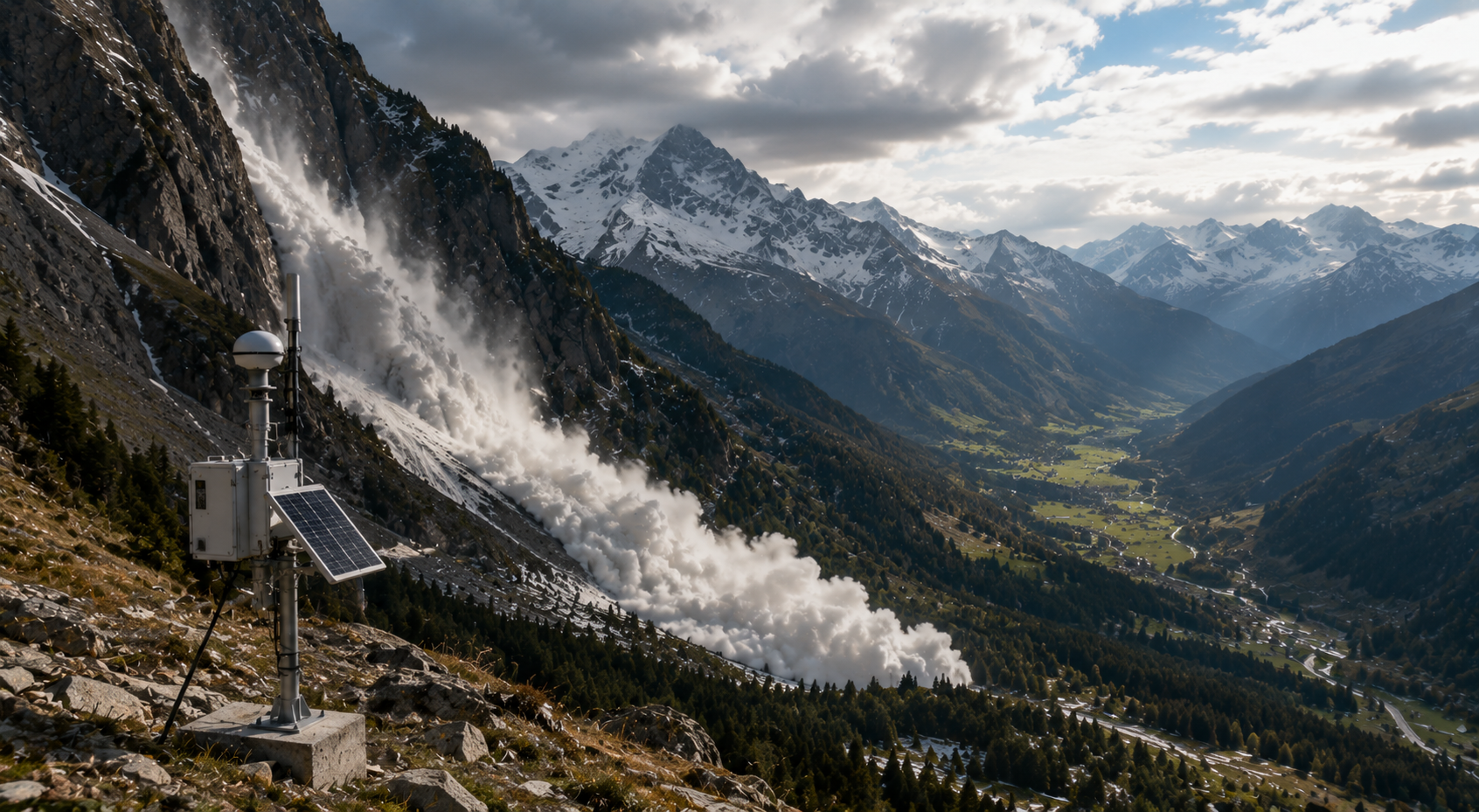
AI early warning systems are becoming an essential part of modern safety, climate, and critical infrastructure. Technologies that once relied primarily on human observation, expert experience, and conventional monitoring equipment are now being enhanced by artificial intelligence, sensor networks, satellite data, and real-time analytics.
A recent example from Switzerland demonstrates how quickly this field is advancing. Researchers at the WSL Institute for Snow and Avalanche Research SLF are developing AI models that can recognise the seismic signals generated by avalanches. The aim is to improve the speed and accuracy of automated detection and early warning systems.
Avalanches, landslides, rockfalls, glacier collapses, and floods are among the most serious natural hazards in alpine regions. They threaten people, transport routes, energy infrastructure, settlements, and tourist destinations.
At the same time, climate change is altering existing risk patterns. Heavy rainfall, heatwaves, glacier retreat, and unstable permafrost can increase the likelihood or impact of dangerous natural events.
As these risks grow, governments, municipalities, infrastructure operators, insurers, and companies need technologies that can identify threats earlier, analyse complex data, and support faster decisions.
Artificial intelligence can serve as a digital early warning layer. It processes large volumes of information, identifies anomalies, and detects patterns that may be difficult for humans or traditional monitoring systems to recognise.
AI cannot prevent natural hazards. However, it can help make risks visible earlier and provide valuable time for protective measures.
How AI Detects Avalanche Signals
Avalanches do not move silently. When large masses of snow travel down a mountain, they generate sound waves and ground vibrations.
These seismic signals can be detected by monitoring equipment. However, vehicles, helicopters, earthquakes, construction activity, and other movements can produce similar vibrations.
Traditional threshold-based systems often struggle to distinguish between a real avalanche and background noise. This can result in false alarms or missed events.
Artificial intelligence offers a more advanced approach.
An AI model can be trained using historical seismic data. Over time, it learns which patterns are typical of avalanches and which signals are more likely to come from other sources.
Instead of detecting only that a vibration has occurred, the system analyses its frequency, duration, intensity, and overall structure.
This makes it possible to distinguish avalanche signals more accurately from unrelated activity.
Historical Data Improves Avalanche Detection
The SLF has collected seismic avalanche data for many years. These historical datasets are particularly valuable for the development of reliable AI early warning systems.
Researchers can use the data to train, test, and continuously improve machine-learning models.
As the models process more verified events, they can become better at identifying relevant patterns and reducing false detections.
In the future, this technology could help authorities identify affected areas more quickly, close roads or railway lines, and warn people in high-risk zones.
Faster detection could be especially valuable in remote regions where visual confirmation is difficult or where dangerous weather conditions limit access.
From Avalanche Detection to Intelligent Infrastructure
The potential of AI early warning systems extends far beyond avalanches.
Similar technologies can be used to monitor:
- Landslides
- Rockfalls
- Debris flows
- Glacier collapses
- Floods
- Wildfires
- Earthquakes
- Coastal erosion
All of these events generate data.
Information may come from ground sensors, satellites, cameras, drones, radar systems, weather stations, or seismic monitoring equipment.
The central challenge is not simply collecting the data. The real challenge is analysing it quickly enough to identify meaningful changes before a disaster occurs.
Modern early warning systems therefore combine multiple technologies:
- Sensors for detecting movement, vibration, temperature, moisture, and pressure
- Satellite data for monitoring large and remote regions
- Artificial intelligence for pattern recognition and prediction
- Edge computing for processing information near the data source
- Cloud infrastructure for storing and analysing large datasets
- Communication networks for delivering warnings
- Cybersecurity solutions for protecting critical systems
Together, these technologies create an interconnected safety infrastructure.
Satellite Data and Natural Hazard Monitoring
Satellite data are becoming increasingly important for natural hazard detection.
Modern radar satellites can detect small movements in rock, soil, ice, and other surface structures. Even changes of only a few centimetres may indicate that a slope, glacier, or geological formation is becoming unstable.
This technology is particularly valuable in remote or inaccessible areas.
Mountain regions, glacier zones, forests, and isolated valleys are often difficult and expensive to monitor using traditional ground-based equipment alone.
Satellites can observe large areas regularly from orbit and provide information even when weather or terrain makes physical access difficult.
Combined with artificial intelligence, satellite data become even more powerful.
AI models can compare current satellite images with historical observations. They can identify unusual movements, changes in vegetation, surface deformation, snow conditions, or water levels.
The system can then help prioritise areas that may require closer monitoring.
Climate Tech and a Changing Risk Environment
Climate change does not affect every natural hazard in the same way. However, it is changing the conditions in which many hazards occur.
Heavy rainfall can increase the risk of floods and landslides. Rising temperatures can contribute to glacier retreat and unstable permafrost. Longer dry periods and heatwaves can increase wildfire risk.
These developments are increasing the need for climate adaptation and resilience technologies.
While many climate investments focus on reducing greenhouse gas emissions, adaptation is becoming equally important.
Governments, cities, infrastructure operators, and businesses must prepare for climate-related risks that can no longer be avoided completely.
Relevant technologies include:
- Natural hazard monitoring
- Flood protection systems
- Satellite-based Earth observation
- Weather and climate analytics
- Critical infrastructure protection
- Insurance risk modelling
- Emergency communication systems
- Digital twins of landscapes and cities
- AI-powered forecasting tools
AI early warning systems are therefore part of a broader Climate Tech and infrastructure investment trend.
Why Artificial Intelligence Is Essential
Natural hazards are complex.
Warning signals can be weak, incomplete, or difficult to separate from background noise. A mountain slope may move by only a few millimetres. A seismic signal may be obscured by traffic or construction activity.
At the same time, weather data, terrain information, snowpack models, water levels, and historical events may all need to be evaluated together.
Artificial intelligence is particularly effective in situations involving large datasets and complex relationships.
AI models can analyse historical information, classify new measurements, and detect correlations that traditional systems may overlook.
However, artificial intelligence does not replace human expertise.
Natural hazard specialists remain essential for interpreting results, evaluating local conditions, and making critical decisions.
The most effective systems combine human knowledge with machine-based analysis.
AI can process information faster and provide an additional layer of insight, while experts assess the wider context and determine the appropriate response.
Investment Opportunities in AI Early Warning Systems
AI early warning systems connect several long-term investment themes.
They require advanced hardware, software, infrastructure, and specialised services.
This creates opportunities across an entire technology ecosystem.
Data Infrastructure
Early warning systems generate large quantities of real-time data.
This information must be transmitted, stored, processed, and analysed. As a result, demand is increasing for cloud platforms, data centres, edge computing, specialised software, and high-performance computing infrastructure.
Sensors and Semiconductors
Intelligent monitoring systems depend on advanced hardware.
Seismic sensors, radar systems, cameras, satellite components, communication equipment, and energy-efficient chips are essential parts of modern warning infrastructure.
Satellite Technology
Earth observation and satellite communications are becoming increasingly important.
Satellites can monitor large areas, provide geospatial information, and transmit data from remote regions.
AI Software
Software for anomaly detection, image analysis, prediction, and pattern recognition can be applied across many industries.
Potential markets include natural hazard monitoring, insurance, agriculture, energy, logistics, industrial safety, and infrastructure management.
Climate Resilience
Resilience is becoming an economic priority.
Companies and governments must protect physical assets, transport networks, energy systems, and supply chains against climate-related and natural hazards.
Technologies that identify risks earlier may help reduce damage, lower costs, and improve operational continuity.
Relevance for Thematic Investment Portfolios
The development of AI early warning systems aligns with several long-term investment themes.
AI Infrastructure Portfolio
The AI Infrastructure Portfolio may benefit from rising demand for computing power, data processing, cloud platforms, and artificial intelligence models.
Early warning systems show that AI is moving beyond digital applications and becoming integrated into physical infrastructure.
Innovation Portfolio
The Innovation Portfolio focuses on companies that transform scientific and technological advances into commercial solutions.
AI-supported natural hazard monitoring is a clear example of research, software, sensors, and data analytics addressing real economic and social challenges.
Green Tech Portfolio
The Green Tech Portfolio is relevant because climate adaptation and resilience are becoming essential parts of the green transition.
Reducing emissions remains important, but societies must also invest in technologies that protect people, infrastructure, and economic activity from climate-related risks.
NextGenTec Portfolio
The NextGenTec Portfolio is connected to this trend through technologies such as semiconductors, satellite data, AI software, sensors, communication networks, and digital platforms.
These technologies are likely to play an important role in the next generation of infrastructure.
Switzerland as a Centre for AI and Avalanche Research
Switzerland is well positioned to contribute to the development of AI early warning systems.
The country has a long tradition of avalanche research, alpine risk management, precision engineering, and infrastructure monitoring.
It also has strong capabilities in artificial intelligence, data analysis, scientific research, and advanced sensor technology.
The Swiss Alps provide a valuable real-world environment for testing warning systems under challenging conditions.
Research institutes, universities, public authorities, and technology companies can work together to develop and validate new solutions.
Technologies developed for avalanches, rockfalls, or glacier collapses in Switzerland may eventually be applied in other regions.
Natural hazards affect mountain ranges, coastal zones, river basins, permafrost regions, and densely populated areas around the world.
Risks and Limitations of AI Early Warning Systems
Despite their potential, AI early warning systems face several challenges.
Natural disasters are often rare and unpredictable. This means that researchers may have limited data from major historical events.
Small events can also be difficult to distinguish from background noise.
Data quality is another important factor. An AI model is only as reliable as the data used to train and operate it.
Incorrect, incomplete, or biased data can lead to inaccurate results.
Responsibility is also a key issue.
Authorities and system operators must decide when to close a road, stop a railway line, evacuate a community, or trigger an alarm.
False alarms can reduce trust and create unnecessary costs. At the same time, systems must not ignore genuine danger signals.
Cybersecurity must also be considered. Critical warning infrastructure must be protected against technical failures, manipulation, and cyberattacks.
AI should therefore be viewed as one component of a broader safety strategy rather than a complete replacement for existing systems.
Conclusion: AI as a Protective Layer for the Physical World
AI early warning systems demonstrate how artificial intelligence is expanding beyond software, digital assistants, and online platforms.
AI is becoming part of physical infrastructure in mountains, valleys, cities, transport networks, energy facilities, and high-risk regions.
The example of Swiss avalanche research shows how artificial intelligence can analyse seismic signals, evaluate satellite data, identify patterns, and support specialists in critical situations.
This development is creating a growing market at the intersection of artificial intelligence, Climate Tech, sensor technology, satellite data, cybersecurity, and critical infrastructure.
For investors, the trend is relevant because it combines several structural growth drivers:
- Artificial intelligence
- Data infrastructure
- Climate adaptation
- Security
- Digital transformation
- Satellite technology
- Advanced sensors
The next phase of artificial intelligence will not take place only in data centres and chatbots.
It will also emerge wherever data and technology can help protect lives, strengthen infrastructure, and reduce economic losses.
External Sources and Further Reading
SRF / SWI swissinfo.ch
An AI Model Listens to the Mountains to Warn of Avalanches
https://www.srf.ch/news/dialog/kuenstliche-intelligenz-ein-ki-modell-belauscht-die-berge-um-vor-lawinen-zu-warnen
Swissinfo
Swiss AI Model Listens to the Mountains to Detect Avalanches
https://www.swissinfo.ch/ger/schweizer-ki/schweizer-ki-modell-belauscht-die-berge-um-lawinen-zu-erkennen/90988117
WSL / SLF
Avalanche Seismic Monitoring for Automated High-Resolution Forecasting and Characterization
https://www.wsl.ch/en/projects/avalanche-seismic-monitoring-for-automated-high-resolution-forecasting-and-characterization/
WSL
Natural Hazards
https://www.wsl.ch/en/natural-hazards/
Federal Office for the Environment – FOEN
Natural Hazards: In Brief
https://www.bafu.admin.ch/en/state-naturalhazards
Swiss Agency for Development and Cooperation – SDC
Satellite Early Warning System for Natural Hazards
https://www.deza.eda.admin.ch/en/satellite-early-warning-system-for-natural-hazards
SLF
Automated Detection of Avalanches in Remote Sensing Data
https://www.slf.ch/de/projekte/automatische-detektion-von-lawinen-in-fernerkundungsdaten/