

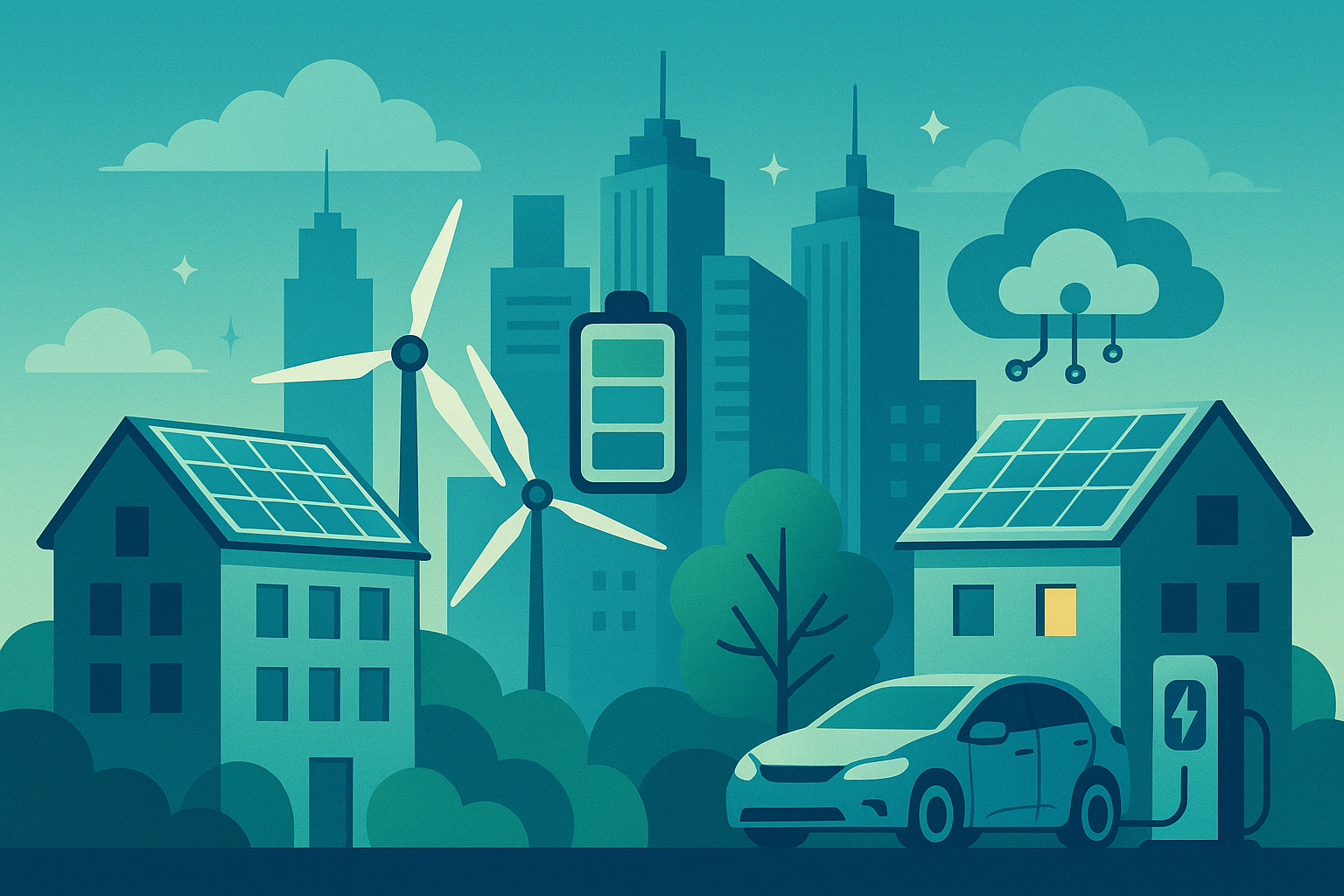
Energy efficiency and digitalization are at the center of a historic transformation of our cities. For the first time in human history, more than half of the world’s population lives in urban areas — and the trend is rising rapidly. But the denser our cities grow, the greater their energy demand, resource consumption, and influence on the global climate. At the same time, digitalization opens a window of opportunity we have never seen before: buildings, streets, transportation, energy systems, and public services can be intelligently networked, controlled, and optimized.
Energy Efficiency: The Invisible Revolution
Energy efficiency is considered one of the quiet but most powerful levers in global climate protection. Though it may sound technical, it has a profound impact on everyday life. Modern buildings can drastically reduce their energy consumption without sacrificing comfort — in fact, intelligent systems often improve indoor environments.
A central component is building technology: automatic heating controls, self-regulating lighting, optimized insulation, and energy-efficient cooling work together like a well-coordinated team. They react to temperature, daylight, air quality, and even the number of people in a room.
Through such innovations, energy is no longer wasted — it is deployed exactly where it is needed.
Typical examples of modern efficiency technologies include:
-
adaptive heating and cooling systems
-
LED lighting with presence sensors
-
intelligent insulation materials
-
automatic shading and sun-protection systems
This creates an interplay of technology, architecture, and environment that significantly reduces the energy demand of entire districts.
Smart Grids – The Digital Nervous System of the City
While conventional power grids operate like rigid systems, smart grids behave more like an intelligent organism. They understand how much energy is needed where, when renewable energy is available, and how surpluses can be stored efficiently.
Particularly with the integration of solar and wind energy, these digital grids are indispensable. They help balance fluctuations in renewable energy production and distribute electricity to where it is needed in real time.
Smart grids can:
-
balance generation and consumption in real time
-
integrate local batteries and neighborhood storage
-
intelligently manage EV charging infrastructure
-
prevent peak loads and stabilize the grid
-
enable decentralized energy supply
This makes energy systems not only more sustainable but also more resilient to disruptions and extreme weather.
Intelligent Buildings – When Structures Become Energy Actors
Next-generation buildings are far more than four walls: they can produce, store, and in some cases even share energy. Photovoltaics on rooftops, heat pumps in basements, and battery storage systems transform them into small power plants.
Modern energy management systems create a new model: buildings become prosumers — both producers and consumers.
They can use surplus energy:
-
internally,
-
store it in batteries,
-
supply it to electric vehicles, or
-
share it within local networks.
This increases independence and strengthens the energy efficiency of entire neighborhoods.
Digitalization & IoT – When Cities Learn to Optimize Themselves
The real magic of the future city emerges when data is used intelligently. Millions of sensors in streets, traffic lights, buildings, and vehicles generate information that the city can analyze in real time.
Traffic can be managed more smoothly, street lighting can adapt to actual needs, and water consumption can be monitored more precisely. Even waste management becomes more efficient when containers signal when they need to be emptied.
Examples of IoT applications in modern cities:
-
adaptive traffic control to reduce congestion
-
intelligent streetlights
-
air-quality monitoring with automated responses
-
data-driven building management systems
-
smart mobility solutions for sustainable transportation
A connected city doesn’t just react — it learns and continuously improves.
Rethinking Mobility: Clean, Quiet, Intelligent
Mobility is often the most visible area of urban transformation. Modern cities increasingly rely on climate-friendly, connected mobility solutions:
-
autonomous electric shuttles
-
intelligent parking guidance systems
-
sharing models for bikes, cars, and scooters
-
charging infrastructure integrated into smart grids
-
AI-supported traffic optimization
This makes mobility cleaner and more flexible while freeing up urban space for green areas and community spaces.
Challenges – And Why the Effort Is Worth It
The transition to smart cities is complex. High costs, data protection, cybersecurity, and technical integration pose significant challenges. Yet the long-term benefits are enormous: lower energy consumption, cleaner air, improved quality of life, and sustainable economic growth.
Many cities around the world already demonstrate that the investments pay off — also financially, as more efficient systems save significant resources over time.
A Look Toward 2040: The City as a Living Organism
Imagine a city that thinks along with its inhabitants: buildings generate their own electricity, streetlights illuminate only when people are nearby, and the traffic system detects congestion before it occurs. Waste is collected only when containers are full, and thermal energy is efficiently shared across districts.
It is a city that conserves resources, reduces environmental burdens, and offers its residents the highest quality of life — a harmonious interplay between people, nature, and technology.
References
Scientific Studies
ScienceDirect – Urban Energy Transition in Smart Cities
https://www.sciencedirect.com/science/article/pii/S2666188825005052
MDPI – Smart Grids and Renewable Energy Systems
https://www.mdpi.com/1996-1073/18/7/1618
ResearchGate – Smart Cities and Urban Energy Planning
https://www.researchgate.net/publication/381234387_Smart_Cities_and_Urban_Energy_Planning
Institutions
International Energy Agency (IEA) – Energy Efficiency Report
https://www.iea.org/reports/energy-efficiency
European Commission – Smart Cities Marketplace
https://smart-cities-marketplace.ec.europa.eu
EnergieSchweiz – Sustainable Urban Development in Switzerland
https://www.energieschweiz.ch
Analyses & Expert Reports
McKinsey – Smart Cities: Digital Solutions for a More Livable Future
https://www.mckinsey.com/capabilities/sustainability/our-insights/smart-cities-digital-solutions-for-a-more-livable-future
Quality Press
Handelsblatt – Digitalization & Urban Innovation
https://www.handelsblatt.com/themen/digitalization
🔗 More Knowledge & Insights
Discover more fascinating articles, news, and future topics here:
https://globalstrategic.ch