

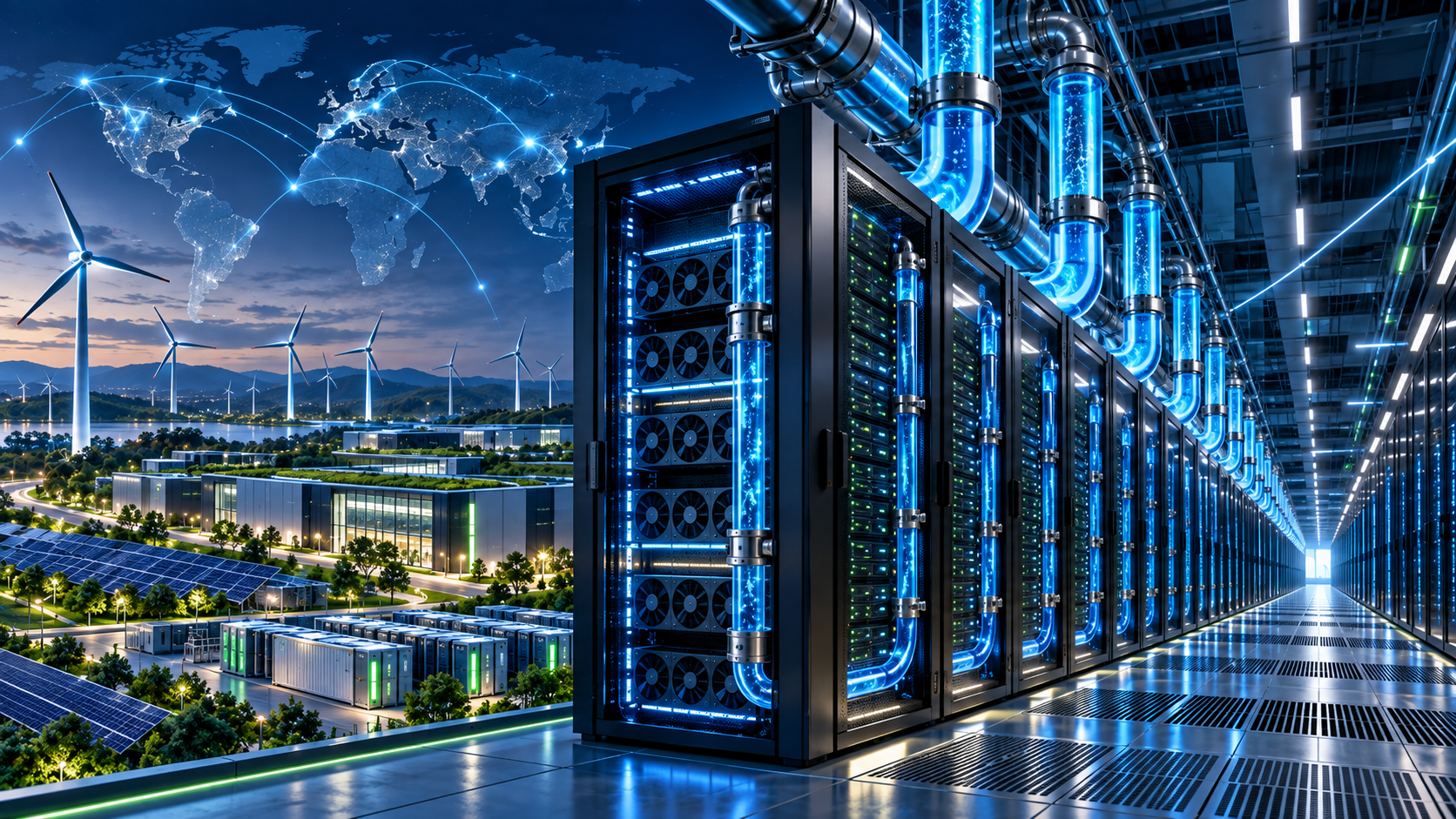
AI infrastructure often remains invisible when artificial intelligence is discussed. The focus is usually on chatbots and algorithms. Behind them, however, lies a complex physical infrastructure: data centers with secured energy supply on the scale of a small city, redundant power-management and backup systems, high-performance cooling for GPU clusters, orchestration software, sophisticated security concepts and cybersecurity.
This complexity is precisely where the investment opportunity lies. It creates a broad value chain in which not just one company, but an entire ecosystem of specialized market leaders can benefit. Understanding this chain also means understanding where the real value of the AI boom is being created.
Investment Process: Discipline and Systematic Selection
The AI Infrastructure Portfolio does not rely on subjective assessments of individual stocks. Instead, it follows a systematic, rule-based selection process designed to deliberately eliminate emotions and individual opinions.
Since the beginning of the year, the portfolio has generated a return of 33.23%, accompanied by a Sharpe Ratio of 1.46and a Sortino Ratio of 2.86.

A Megatrend at an Early Stage
A look at the global data-center pipeline confirms the picture: the expansion is still at an early stage. According to Cushman & Wakefield, planned capacity significantly exceeds operating capacity across the regions covered.
| Region | Operating | Under Construction | Planned |
|---|---|---|---|
| Americas | 43.4 GW | 25.3 GW | 191.3 GW |
| EMEA | 11.4 GW | 2.7 GW | 12.1 GW |
| Asia-Pacific | N/A¹ | 4.8 GW | 21.7 GW |
¹ Cushman & Wakefield does not report cumulative total operating capacity for APAC, but only additional capacity in the first half of 2026 of 1.4 GW.
Source: Cushman & Wakefield, Global Data Center Market Comparison 2026 / APAC Data Centre H1 2026 Update.
These figures illustrate that today’s infrastructure base represents only a fraction of what still needs to be built in the coming years. For investors in the AI Infrastructure Portfolio, this means that much of the growth potential still lies ahead.
Why Demand Is Structural — Not Cyclical
Demand for data centers does not come from a single source. Instead, it is driven by several overlapping factors.
Consumer demand: Billions of users worldwide access chatbots and AI assistants every day, creating a broad and steadily growing base level of demand.
Enterprise adoption: Companies are increasingly deploying their own AI models, copilots and private AI infrastructure in production. According to the market analyses referenced in the Investment Update, this segment shows the highest growth rate among the demand sources as organizations move from pilot projects to broader operational use.
Agentic AI as an accelerator: Instead of generating a single request, an AI-driven task can trigger dozens or even hundreds of individual computing steps. The AI independently calls tools, retrieves information and coordinates multi-step workflows. This multiplies the computing demand per task.
Shift from training to inference: According to Deloitte, the ongoing operation of already-trained models — inference — will account for around two-thirds of total AI computing demand in 2026.
Sovereign AI demand: Governments are increasingly investing in their own AI infrastructure for defense, public services and scientific computing.
Traditional digitalization: Cloud migration, cybersecurity and general enterprise IT create a base level of demand that exists independently of the AI cycle.
For investors, the key point is that even if individual components — such as the training cycles of certain models — were to weaken, the other drivers would remain in place or continue to grow. According to the Investment Update, this supports a structural rather than cyclical growth profile for the underlying infrastructure demand.
Green Technology: Efficiency Becomes a Key Factor
The rapid expansion of AI infrastructure also has a downside: data centers are among the most energy- and water-intensive buildings of our time.
Investing sustainably in this megatrend therefore also requires consideration of the environmental dimension — from efficient cooling technologies and renewable energy supply to circular concepts for hardware.
Trane Technologies as an Enabler of the AI Infrastructure Boom
The AI boom is creating enormous cooling and energy requirements. This is where Trane Technologies comes in.
For the extreme heat densities of modern GPU clusters, the company offers not only traditional air cooling, but also liquid cooling. Through its LiquidStack subsidiary, the company is also positioned in direct-to-chip and immersion cooling for AI and hyperscale environments.
On the efficiency side, Trane reduces energy demand through demand-based cooling-load management and advanced energy management. It also addresses data-center water consumption through optimized system design.
Thermal designs developed in cooperation with NVIDIA for “AI factories” recently achieved an approximately 10% improvement in overall thermal performance.
Trane Technologies therefore connects two central elements of the investment story: the structural AI infrastructure boom and more efficient use of resources.
Conclusion
The AI boom is more than a software phenomenon — it is a physical infrastructure revolution that is set to unfold over several years.
Global pipeline data shows that today’s expansion represents only a fraction of what is still to come. The AI Infrastructure Portfolio aims to capture this development across the entire value chain through a systematic, rule-based selection process rather than subjective assessments of individual companies.
For investors seeking exposure to the structural growth of digital infrastructure, it therefore offers a disciplined and broadly diversified approach to one of the major investment themes of our time.